
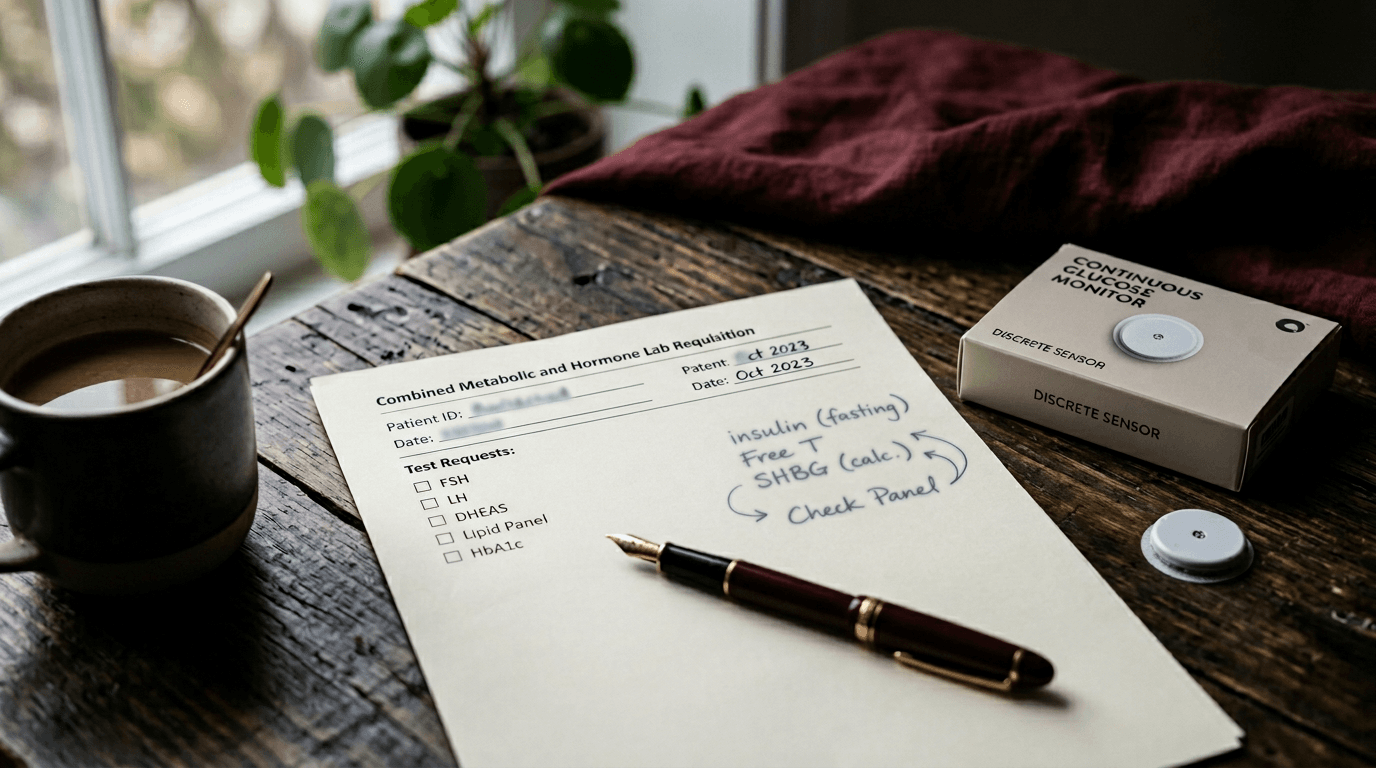
Polycystic ovary syndrome gets diagnosed off symptoms, an ultrasound, or a single elevated testosterone - none of which alone tell a provider what to do. PCOS is a metabolic and hormonal pattern, and the panel that actually moves treatment runs deeper than "borderline polycystic on imaging." Here's what to ask for, and what each marker changes about the plan.
What PCOS actually is - and isn't
PCOS is a syndrome (a cluster), not a single disease. Rotterdam criteria require 2 of 3: hyperandrogenism (clinical or biochemical), oligo/anovulation, polycystic ovarian morphology on ultrasound. "Polycystic ovaries on imaging" alone is not PCOS - up to 25% of normally cycling women have polycystic-appearing ovaries.
The driving mechanism for most cases is insulin resistance. High insulin pushes ovarian androgen production up, drops SHBG, and disrupts the LH/FSH ratio. Treating PCOS without addressing insulin is treating the downstream symptom and missing the engine.
About 10% of PCOS cases are "lean PCOS" with normal BMI but the same insulin and androgen pattern. Body weight is not the diagnostic criterion - the labs are.
The panel that maps the type
Metabolic: fasting insulin, HbA1c, fasting glucose, HOMA-IR, lipid panel with ApoB. Fasting insulin above 10 uIU/mL or HOMA-IR above 2 confirms the insulin-resistant phenotype that responds to metformin, inositol, and (in select cases) GLP-1.
Androgens: total and free testosterone, SHBG, DHEA-S, androstenedione. Total T above 60-70 ng/dL with low SHBG drives the hirsutism, acne, and androgenic hair loss picture.
Reproductive axis: LH, FSH, estradiol, progesterone (day 21 if cycling), AMH, prolactin, TSH, free T3/T4, 17-hydroxyprogesterone (rules out non-classical CAH). LH:FSH ratio over 2:1 supports the diagnosis but isn't required.
What each pattern changes
Insulin-driven PCOS (most common): inositol 4 g daily (myo + d-chiro 40:1), metformin 500-2000 mg/day under provider review, protein 0.7-1.0 g per lb lean mass, strength training 3x/week. GLP-1 may be added in BMI-eligible cases when first-line work doesn't move HbA1c.
Adrenal-androgen pattern (DHEA-S elevated more than testosterone): targets stress, sleep, and lower-glycemic eating; saw palmetto and spearmint tea show modest data; provider review before any antiandrogen.
Lean PCOS with normal insulin: focus on cycle restoration via stress, sleep, body composition (sometimes more body fat is needed, not less), and provider-reviewed cyclic progesterone. Fertility planning enters earlier here because ovulation may need help.
What to do now
Run the Advanced lab panel with the full PCOS workup attached - fasting insulin, free T, SHBG, DHEA-S, AMH, LH/FSH, 17-OH progesterone. Bring symptoms (cycles, hirsutism, acne pattern, weight changes) to the assessment.
If you've been told "borderline PCOS" without lab confirmation, the next move is the panel above and a provider call. Treating without a phenotype is how women cycle through metformin, OCPs, and supplements for years without the right one ever sticking.